
At first glance,the moving slideshow of different colours are the elements which attract attention to the website. To add to this, the slideshow presents five different options in which leads to links that relate to fanta. Above the slideshow there are three options in which you can choose from, options such as videos, downloads and flavours. When the mouse is hovered over these options, the colours turn from a semi light orange to a darker orange.The colours used consists of orange, yellow-orange, red-orange and any orange based colour. The vibrances of the site creates a happy mood, this is because the colours associated with this site are warm and it generally gives of that warm and happy feeling. White, is also used as the font on the website. This is because the white stands out which also draws the attention of the customer or reader. This helps because the font is not only big but it stands out in contrast of the orange background.
Images
The
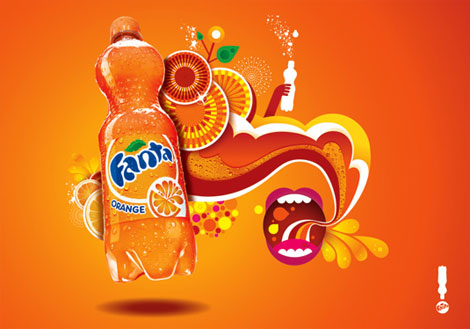
changing slideshow of pictures is the main image on the homepage which
keeps the viewer glued. The images produced on this site are big and the characters used are viewer friendly, which makes the site more attractive.The
changing and dissolving of one picture into another makes it look like the slideshow is giving the viewer a preview of a short movie.This makes the viewer want to see more of the site because of the little previews shown by the site. However, when the mouse is placed on the slide the cursor turns into a hand and when dragged to the words, it highlights the option that you may want, but the slideshow still carries on unless you click on the intended option of your choice. By clicking on your intended choice "the
current page disappears from screen to be replaced, bit-by-bit, by a
new page; this is close to a jump cut in video or film" (Wysocki, 2004). When the page has changed, the current background still remains but the images around is different and so is the information. In addition to that there are also thumbnails which are a sizeable size underneath the main option. The images on the thumbnails do not move, but when the cursor is hovered over it the words are highlighted once again.

Typeface
Extended Links
There are other links at the top of the page, however when you have chosen on these links you will still have the options of returning back to the fanta website. There are different regions/countries in which you can choose from, once you have chosen the region the website directs you to their version of the fanta website, it will most probably be in their language.
Reference
Wysocki, A. F. (2004). The multiple media of texts: How onscreen and paper texts incorporate words, images and other media. In C. Bazerman and P. Prior, (Eds.) What writing does and how it does it: An introduction to analysing texts and textual practices, pp. 123 – 163, Mahwah, NJ, Lawrence Eribaum
